Showing posts with label Obamacare. Show all posts

Tuesday, September 10, 2013

How Badly Obamacare Beat Up On the Health Insurers, and What Does It Mean for the Individual Market

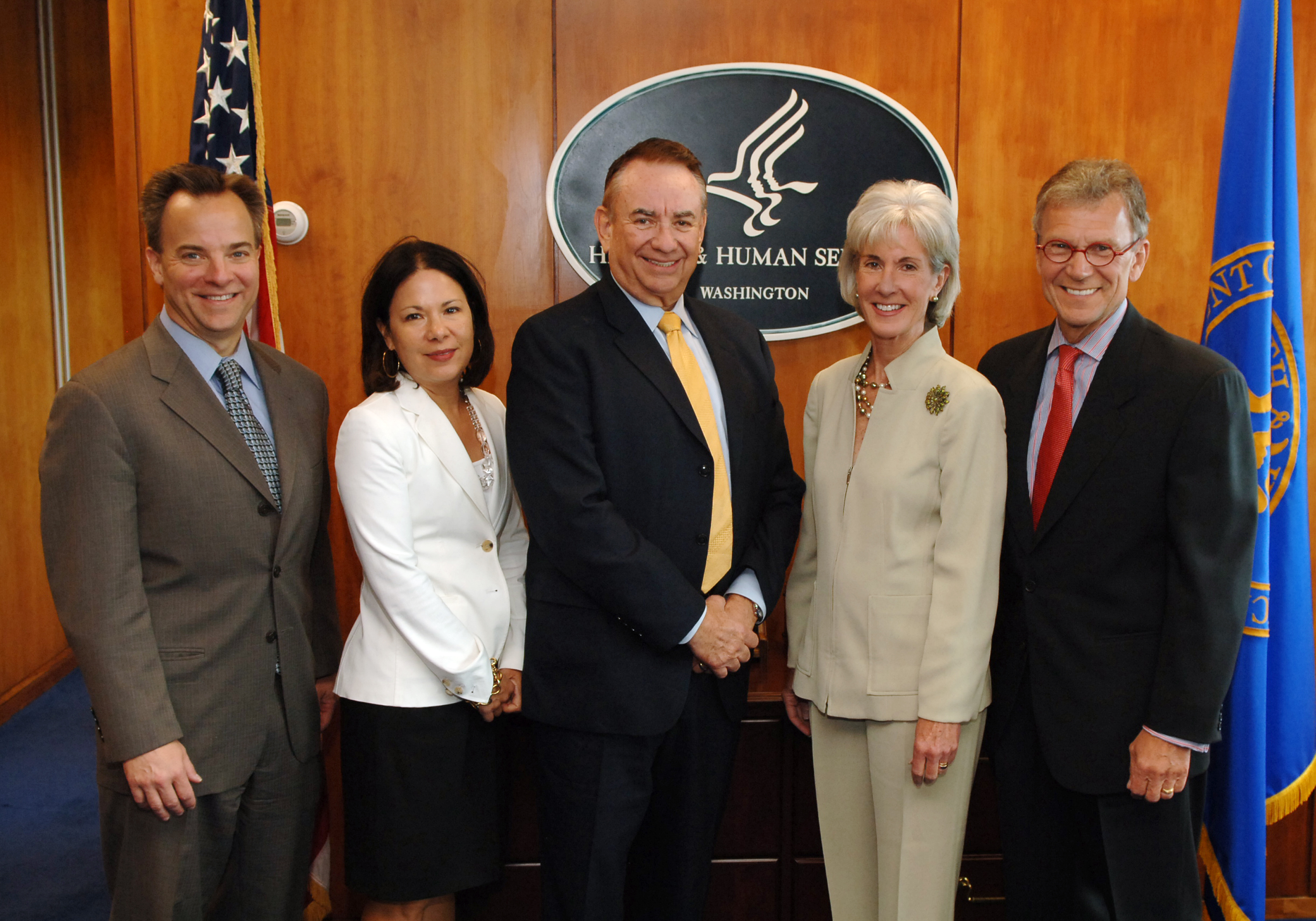
D.C. deals with health insurers
As Disease Management Care Blog readers are aware (for example, here and here), Obamacare forces health insurers to spend at least 80% (small group) to 85% (large group) of their premium income on health care, leaving only 15% for "other," including administrative overhead and profits. If that 80%-85% "medical loss ratio" (MLR) threshold is not met, insurers have to rebate the difference to their customers.

 While the White House has been happy to extoll the millions of dollars that were repaid to consumers (even though the individual checks were hardly eye-popping and then there is the risk that they're taxable), the DMCB is interested in what actually happened to the commercial insurers.  Did they game the system and garner even higher profits?  Or, have they gotten their comeuppance, are now losing money and have to pursue other lines of business, like covering zombie attacks?

This article in the latest Health Affairs looked at that impact of the law when it went into effect on January 1, 2011.  The authors used NAIC data to examine the impact on the individual (N=1,219), small group (N=804) and large group market (N=750) insurers.

Individual, small group and large group numbers are broken out below. If there is a *, the change is statistically significant.

In the individual market, from 2010 to 2011:

Median medical expenses, as a percent of premium, increased      by 5.5%*.
Administrative expenses, as a percent of premium, decreased            by 2.6%*.
Profit (otherwise known as "operating margin" or the bottom line) decreased by 1.3%*. "For profit" insurers fared even worse, with a decline in operating margin of 2.2%* vs. their nonprofit competition with a decline in 0.8%.

2011 operating margins were overall negative:

Individual overall -0.1%.
Nonprofits:  -3.5%.
For profits:  0.4%.

In the small group market:

Median medical expenses increased by 0.7%.
Median administrative expenses declined by 1%*.
The bottom line increased by .5%. Nonprofits saw an increase of 1.2%* vs. the for profits having a small decline of .3%.

2011 operating margins were positive, ranging from 2.8% to 3.8%  across the non and for profits, respectively.

In the large group market:
Median medical expenses declined by 0.7%.
Median administrative expenses declined by 0.9%%*.
Profit increased by .7%*. Nonprofits saw an increase of 0.1%* vs. the for profits having a increase of 1.2%.

2011 operating margins were positive, ranging from .7% to 2.6%  across the non and for profits, respectively.

The DMCB's take:

Obamacare had a single digit impact on health insurers.  More was spent on health care and less was spent on administrative costs.  While the shifts were relatively small, those changes represent swings of hundreds of millions of dollars to the bottom line in an already thin margin business. If the purpose of Affordable Care Act was to beat up on the health insurers, it was more of a push than a shove.

Small and large group profitability increased and operating margins were positive, while the individual market struggled. As readers may recall, the inability of individuals to obtain coverage at any price was a big factor in the eventual passage of the Affordable care Act. While the future individual market may eventually benefit from an influx of healthy young "invincibles" armed with an accompanying bolus of insurance subsidies, Obamacare ironically hurt the individual market in 2011. If health care utilization didn't go down in 2011 as a result of the economy, it could have been a lot worse.

That tells the DMCB that, contrary to the insurers' reports of doom and gloom, the 80%-85% MLR rule hasn't been a catastrophe.  On the other hand, it hasn't been good news for the individual market.  If the young invincibles don't 1) respond to the individual mandate, 2) use functioning insurance exchanges and 3) sign up, it could portend further stress on that sector of the health care economy.  No wonder the Obama Administration is pushing that so hard.

Wednesday, September 4, 2013

Real News Headline: Improved U.S. Health Care System Saves 28,000 Lives in 2010, Avoidable Death Rate is Decreasing

Health reporters at work
When the major news media organizations (for example, here and here) proclaimed that 200,000 cardiovascular deaths in the U.S. could be avoided every year, the Disease Management Care Blog decided to learn more.

The information reported in the media was taken from the Centers for Disease Control and Prevention's Sept. 3 Morbidity and Mortality Weekly Report. As the DMCB understands it, the CDC authors pulled 2001-2010 mortality data from the National Vital Statistics System. Once that was done, they counted up the number of persons aged less than 75 years who died of "ischemic heart disease," "cerebrovascular disease," hypertensive disease" or "chronic rheumatic heart disease."

So what did MMWR really say?

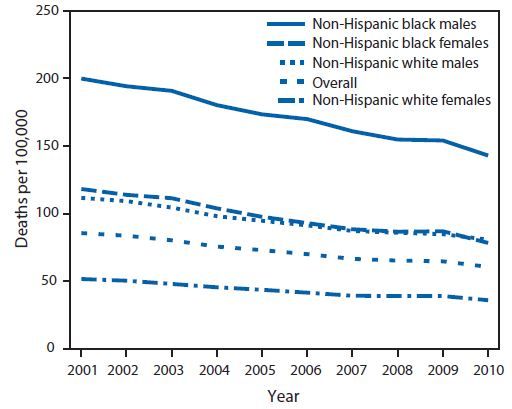
The total of "less-than-75" deaths in 2001 was 227,961.  For 2010, it was lower at 200,070. Since the population in the U.S. has changed over the last decade, the totals for each of the two comparison years were then expressed as a "per 100,000" statistic.

Since 2001, the "less-than-75" death rate per 100,000 declined by 29%.  The decline averaged 3.8% a year.* Persons age 65-74 years had an average decline of 5.1% vs. 3.3% persons between the ages of 55-64. 

The good news is that Black (3.9%) and Hispanic (4.5%) persons had greater declines than whites (3.6%). The bad news is that they started and ended with a higher death rate.

Here's a visual display of the data:


 The DMCB's take

1. "Avoidable?" The CDC definition implies that perfect control of all cardiac risk factors (for example, cholesterol and weight) for everyone under the age of 75 will result in a 0 per 100,000 cardiovascular death rate. Not so, because those risk classic factors capture some, but not all, persons who succumb to heart attack and stroke.

2. So, this is bad news?  "200,000" deaths is an impressive number, but, on an unadjusted basis, that's about 28,000 fewer compared to 10 years ago. Some additional good news is that the U.S. rate of non-fatal heart attack and stroke appears to have dropped significantly also.  We are making significant headway in the battle against heart disease.

3. The real story? Persons of color have had the greatest relative benefit but still have the greatest absolute need.  That lingering health care disparity went shamefully unmentioned by CNN and was only briefly mentioned by USAToday.

4. Something for everyone: In their "Conclusions and Comments," the authors of the MMWR paper speculated on the benefits of the (still unproven) Million Hearts Initiative (a Berwick-era idea) as well as "health information technology" and various "community prevention strategies" The DMCB's colleagues in the care management service industry will really like the authors' nods toward "team based care" and how "individuals can work toward reducing their own heart disease and stroke risk."  If the CDC says so, it must be true - assuming there's a good business model.

5. Speaking of speculation, the authors wondered if the greater decline in the Medicare age group (65-74 years) versus the younger age group (55-64) was because of the presence of health insurance. Maybe, but maybe not.  The DMCB also wonders if heart disease is more lethal and less amenable to intervention among younger persons, but can't find any literature to back that up.

6. Politics intrude:  Naturally, the scientists who write MMWR are too classy than to curry favor with the appointees that populate the upper echelons of the federal bureaucracy, but that didn't stop the CDC Vital Signs from shamefully putting in a "making it easier for Americans to afford regular preventive health care through the Affordable Care Act" plug.  The ACA was not mentioned in the MMWR report because the declines mentioned above occurred in the absence of the ACA. 

The DMCB predicts that when the "avoidable" death rate continues to decline by 3.8% in the coming years, Obamacare advocates will take the credit.


*The DMCB isn't sure how 3.8% for 10 years makes for 29% either, but that's statistics for you.

Image from Wikipedia

Tuesday, August 13, 2013

Suggestions for Managing Health Reform in 2014

Unfortunately for Mr. Obama, the spotlight on the some of the more unsavory aspects of the NSA's surveillance programs has forced him to call for "changes." In doing so, he turned to every rhetorical trick at his command, including minimizing Snowden's role, obfuscating the original intentions of the Patriot Act's authors and countering with largely cosmetic tweaks.

Good thing that Obamacare has avoided a similar fate. Despite similar levels of public skepticism further compounded by the steady drip of implementation delays with other unintended consequences, the President can hang tough by resisting any and all statutory changes to the Affordable Care Act. Signaling any willingness to alter the legislation could embolden his foes, dismay his allies and prompt countless poison pill amendments.

The obvious political calculus:  silence, veto threats and burying any changes in web site legalese.

Yet, the ever-prepared Disease Management Care Blog wants to help.  In the unlikely event that Mr. Obama has to compromise on health care reform without really compromising, it offers up this teleprompter-ready statement that incorporates condescension, selected truths and confusion:

"Despite my calls for bipartisan dialogue on how to further vilify fat-cat insurance executives, the debate on how to best implement Obamacare has proceeded in a not-always civil way. Like the DMCB's mother, I'm not angry, I'm disappointed. [applause] 

While I'm annoyed at the failure of my supporters and opponents to grasp the obvious, I'm also reassured that 20% of our nation's GDP is being expertly managed by our superbly trained White House health economists. [applause]  You should be too.  [applause]

I also know that continued unmanaged debate could complicate health care reform faster than one of my lawyer-friends suing an ACO for withholding care. That's why, effective today, I'm changing the subject by announcing that I will meet with hand-picked members of Congress.  I'll seek to improve the public's confidence in Obamacare by creating legislation that establishes the Commission of Official Managerial Assessment (COMA).  This will be a special office within the IRS. This expert commission will monitor, report, assess, analyze, examine, subpoena, audit, interpret, leak, manage, spin and regulate key aspects of Affordable Care Act's implementation.

Image from Wikipedia

Wednesday, August 7, 2013

Insights on Delaying Obamacare's Employer Mandate: Four Potential Unintended Consequences?

Which is it?
Look at we did!

Delaying the employer mandate for one year is simply more evidence of Obamacare's unworkable complexity, says detractors.

The delay is flexibility and democracy in action, says supporters. 

The Disease Management Care Blog is troubled by how Congress and the Obama administration underestimated the complexity of the local implementation of a one-size-fits-all national health program.  It also knows that the White House needs some Affordable Care Act (ACA's) elbow room.

To gain a better understand what's going on, check out this article appearing in the New England Journal. 

Recall that the intent of the ACA was to preserve employer-based insurance while enabling individuals to access similar levels of coverage in on-line exchanges. Toss in some income-based subsidies on the upside along with IRS penalties on the downside, and the intended outcome is that millions of Americans will enter the national risk pools. That, in turn, should lead to premium drops and greater access to health care.

So what could be the impact of the delay?

First off, there's what won't happen. The authors estimate that 2014 will be business-as usual for the vast majority of persons with employer-based insurance.

But here's four things that could happen:

1. Approximately 5 million part-time workers may be closed out from access to their employer's insurance for another year. In addition, the $10 billion in government income from the $2000-per-worker) will be lost.  Both these numbers are small potatoes in a trillion-dollar enterprise involving tens of millions of workers, unless, of course, you happen to be one of those workers.

2. Millions of employed full time workers will continue to take a pass on taking the paycheck deduction for their employer-based insurance.  Whether they change their mind in 2014 will not depend on how hard their employers work to sign them up, but how aggressively the IRS pursues the individual mandate. 

3. Attached to the employer mandate were regulations that would have forced employers with a workforce of greater than 50 persons to offer competitive (read "low") insurance premiums.  Since that's also been delayed, employers and their employees who want insurance have an even greater incentive to access the on-line individual exchanges.  Employers get to reduce their insurance costs while individuals get to take advantage of those upside subsidies. The employer-employee win-win arrangement could not only undercut employer-based insurance, but "triple" the Fed's subsidy budget.

4. The DMCB's physician colleagues are not immune either.  There is emerging evidence that the individual exchanges are likely to offer "frugal" insurance plans.  Early indications are that these plans will turn to the old tricks of restricted networks and low provider reimbursement levels. This could result in millions of newly insured persons further stressing an overloaded primary care provider network.

Tuesday, July 23, 2013

Leveraging Celebrities to Market Obamacare

According to this The Hill article, President Obama took a break from tackling red lines, gun control, immigration reform, Trayvon Martin, the economy to make an appearance at a July 22 Obamacare promotion-planning meeting that included a host of A-list celebrities.  They'll be needed to convince the young invincibles to pony up hundreds of dollars for health insurance that they don't want.

Despite the DMCB spouse's unflattering assessment of her husband's media chops, the Disease Management Care Blog thinks it should have been in that White House room. 

It has a lot to contribute.

For example, American Idol finalist Jennifer Hudson was there.  How about a new CMS-sponsored talent show, says the DMCB, that is hosted by Ms. Hudson, called American Muddle? Enter the early crooning favorite, Hope Igeddadok, singing a reprise of that Dire Straits hit, "Money for Nothing."

And what about Improv comedy artist Amy Poehler? After a great stint at SLN, she went on to star in the hit comedy show, Parks and Recreation.  The DMCB suggests a pro-Obamacare commercial that features Deadlock and MakeItUpAsWeGoAlongination.

And fresh from being tossed under the campaign bus by Valerie and Michelle, Oprah Winfry is back in play. Given Oprah's masterful interview of disgraced bicyclist Lance Armstrong, positively spinning Obamacare and the IRS should be a piece of cake. First up, the IRS Chief Counsel!

Alicia Keys was there and can she sing! She can be this "Girl Is On Hire" for Obamacare in an MTV video-advert.

And it was no accident that Bon Jovi's people were there, what with a song list that includes "Livin' on a Payor," "Panel Says Dead or Alive," "It's My Right," "You Give Hope a Bad Name," "Runaway Costs," "Bad Medicine" and "Shot Through the Heart and We'll Still Pay."

Last but not least, folks must have been excited about Will Ferrell. Since his Bush impersonation has run its course, Ron Burgundy may be the best choice for some faux-news insights.  He can provide periodic updates on how the health insurance exchanges are going: "They've done studies you know," "Sixty percent of the time it works every time," "In a glass case of emotion," and "Stay classy, Obamacare."

If anyone in the White House is reading this, just drop an email.  The DMCB is ready to roll up its sleeves and help.